(18)

Cleaning up our campaign finance system

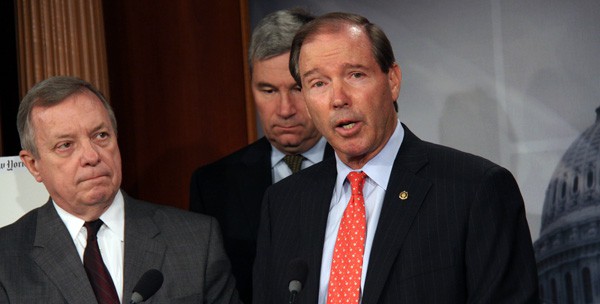
U.S. Sen. Tom Udall, D-N.M., shown here announcing his proposed constitutional amendment on Tuesday with colleagues who support his effort. (Courtesy photo)

We cannot stand idly by and watch our elections be fundamentally degraded by a flood of unaccountable money into the system. That is why I have introduced an amendment to the United States Constitution to address our country’s broken campaign finance system.

As we head into another election year, New Mexicans are about to be bombarded with negative attack ads paid for by anonymous, third-party organizations that dominate our TVs and radios in growing numbers each election cycle. We will see an unprecedented amount of money in our elections, and more than ever it will be coming from corporations and outside special interests.

We cannot stand idly by and watch our elections be fundamentally degraded by a flood of unaccountable money into the system. That is why I have introduced an amendment to the United States Constitution to address our country’s broken campaign finance system.


Advertisement

Joining me in this effort are my colleagues, Senators Bennet, Harkin, Durbin, Schumer, Merkley, Whitehouse, Begich and Shaheen. We believe our campaign finance system should be subject to commonsense regulations that reinforce the spirit of democracy. Our constitutional amendment would allow Congress to get to the root of problem and address the virtually unlimited corporate and special-interest spending in elections.

How we got here

Over the past 10 years, the influence of corporations and special interests in political campaigns has exploded. Each time a regulation is put in place, special interests circumvent the rules through legal loopholes or use the courts to strike down the law. The problem isn’t one particular law or judicial decision; it’s the fact that Congress can no longer effectively regulate the flow of money into campaigns. The only sure fix is a constitutional amendment that gives Congress the authority to reform the campaign finance system.

We didn’t get here over night. The Supreme Court has issued a series of bad decisions that have crowded and distorted our elections with a flood of corporate and special-interest money that can swing an election one way or the other. In 1976 the Supreme Court laid the groundwork for a broken system in the Buckley v. Valeo decision. In that case, the Court incorrectly decided that imposing modest restrictions on campaign expenditures violates the First Amendment right to free speech. This established the flawed precedent that money and speech are the same thing – something I strongly disagree with.

More recently the Supreme Court issued an even worse decision in Citizens United v. FEC. In this case, they granted the same free-speech rights to corporations and other special interests that the Constitution guarantees to individuals. With Buckley v. Valeo equating money to speech, and now Citizens United giving Free Speech rights to large corporations and interest groups, the political system is becoming evermore unbalanced.

While the average American only has one vote and limited resources to contribute to political candidates, these organizations can now pour vast sums of money into advertising that influences the outcome of our elections. As a result, in the elections of 2010, New Mexicans and all Americans saw a new breed of attack ads from out-of-state interests. The vast majority were negative. These new organizations raised and spent unlimited funds for the first time since before there was television. In the upcoming 2012 election, you can certainly count on even more.

Restoring a government by the people

With the Supreme Court striking down the sensible regulations Congress has passed, the only way to get to the heart of this problem is to first amend the Constitution.

I believe a democracy is healthy when the crucial battle of ideas is fought out by publicly accountable officeholders, not anonymous special interests over the airwaves. There has to be accountability. Our constitutional amendment would allow Congress to reverse this troubling trend by regulating campaign contributions and expenditures.

This constitutional amendment would:

  • Authorize Congress to regulate the raising and spending of money for federal political campaigns, including independent expenditures.
  • Allow states to regulate such spending at their level.
  • Not dictate any specific policies or regulations, but instead would allow Congress to pass campaign finance reform legislation that withstands constitutional challenges.

Letting this go unchecked is a threat to our democracy and not what our founders envisioned. Campaigns should be about the best ideas, not the biggest checkbooks. It’s time to put elections back in the hands of American voters, not corporations and special interests.

Udall, a Democrat, represents New Mexico in the U.S. Senate.

Tagged as: , , , ,

18 comments so far. Scroll down to submit your own comment.

  1. Thank you wedum59, for validating my read of it and the numerous loopholes that will be exploited by the politicians to keep things the same and their money flowing in from their special interest groups. Of course this has no chance of passing, and hopefully Tom is bright enough to understand that (or is he?), so you do have to wonder what all this fluff and noise and smoke he is pontificating around this (numerous emails have been received about it from his campaign staff) is all about. Obviously he has a political motive for this joust at the windmills, I just wish he would put his time and energy into a Constitutional Amendment that would make a difference in America, like strict term limits on all federal elected officials and federal judges and the Supreme Court justices, strict wage controls on their salaries, and the same benefits for them that the average common person gets in America.

  2. Saturday 11-5-11 Well, having finally read the amendment for myself, I have to modify my praise of it– I see nothing in it that would limit the donors to US citizens that are registered to vote for the specific candidate. Limiting the amount of money that can be contributed is a good idea, but it seems to me the obvious loophole is that the individual rich and the powerful for-profit and non-profit organizations will just spawn millions of separate “organizations,” each of which will be able to contribute whatever maximum amount the Congress sets.

  3. This man is as blind to the needs of the country as is his relative in Colorado. Together they would make up half a brain to think with.

  4. Thanks again to New Mexico’s fine senator for attempting to bring some sanity to our election process. Recall that at the beginning of this session of Congress he proposed a modification of the Senate rules that might have slightly reduced the grid-lock there. But even this very meek Constitutional amendment proposal which still leaves the foxes in charge of the hen house and would create much uncertainty as the actual rules could change with each swing of power in the Congress is doomed to failure.

    Senator Udall doesn’t seem to understand how dedicated the 1% is to having 100% of everything. Although, soon, everything won’t be very much.

  5. Icarus: You beat me to it regarding PGessing’s comments. I guess Mr. Gessing believes in the idiom, “money talks”. I know now why I can’t take much of what he writes seriously.

    Speaking of wasting time, how about US Rep. Forbes’ bill reaffirming “In God We Trust” as our national motto. Now that’s focusing on real problems.

  6. Thank you abqresident for actually reading the text of the amendment. Sounds like it includes the main point I have been advocating, with even more of a limitation: only those who can VOTE for the candidate may CONTRIBUTE to the candidate. That cuts out all the for-profit and non-profit organizations. Perhaps Emily’s List could still “bundle” donations, but only from members who can vote for that specific candidate. Terrific.

  7. Mr. Guessing…You are so not pollitically correct…That sure works for me!.

  8. Mr. Gessing:

    You’ve apparently never read a dictionary, under which “money” is included nowhere in the definition of speech. Considering that you once wrote an entire column in which you confused the Constitution with the Articles of Confederation and are an MBA with a notoriously lax research-ethic, do you really want to be trying to explain the Constitution to an accomplished lawyer and United States Senator?

  9. Udall has apparently not read the US Constitution which states: “Congress shall make no law respecting an establishment of religion, or prohibiting the free exercise thereof; or abridging the freedom of speech, or of the press; or the right of the people peaceably to assemble, and to petition the Government for a redress of grievances.”

    I realize that he and his cronies (of both parties) in Washington have not cared about the Constitution for many years, but it is worth noting that restricting political speech is still restricting “free speech.”

  10. Well, it’s not liberalism anymore, is it? It is something else, something dark and evil.

    Might I suggest a change in screenname, “NM Objectivist”? I’ve yet to see you write anything the least bit objective on this site.

  11. Here comes Occupy Wall Street…with this ammendment, no one need ask where’s the beef.

    Udall gives it legs, OWS gives it voice, ears, arms…

  12. “Free speech for me but not for thee,” eh Tom?

    Our founding fathers thought the best way to deal with bad ideas was to allow unlimited speech to let all ideas be heard. They thought the good ideas would drive out the bad ideas. And I agree.

    Hard to believe liberals have come to this — selectively limiting free speech. Well, it’s not liberalism anymore, is it? It is something else, something dark and evil.

  13. Really? Carte Blanc to Congress to make up new rules that we don’t have a clue what they will be? Uhhh…let’s see. “These rules apply to all but the unions, because unions are made up of the people?” Let’s enforce the laws that we have, and work toward a culture that can get back to an understanding of right and wrong.

  14. I clicked on the link to read the amendment. First of all, I must commend the writers for being concise. I do not believe that a bill should be hundreds or thousands of pages. I am suspicious of laws/bills that are that long because I am concerned that there MIGHT BE too many loopholes or conditions in them. I actually have a better solution that would take less than one page.

    Only eligible voters may contribute to any campaign. The eligible voters must be eligible to vote in the election in question. Limits to the value of contributions should be reasonable and set by the jurisdiction in which the election is taking place.

    This means that for the Senators from New Mexico only some one legally eligible to vote for them may contribute. This should satisfy the left by eliminating corporate money and satisfy the right by eliminating union money. Also, what is an appropriate amount of money to run a campaign in New Mexico is completely different that what is appropriate in New York.

    MJM – I totally agree with you. While our “representatives” have been so busy bad mouthing each other and pursuing causes such as these, they can’t even pass a budget. I ask any of the working people that read this site, what would happen if you were unable to do the most basic part of your job for over 2 years. Would you still have the job? Would you still deserve the job? And before you start saying “But the Republicans…..), the Democrats had 2 years where they did not need one single Republican vote to get their job done and they refused. Had they simply done their jobs they could have held that over Republicans for decades.

  15. Excellent point Skeptic, and we all know the lobbyist that buy and pay for the legislators write their bills, as their staffs are not competent for this, so which left wing lobbying group is writing this one? Inquiring minds want to know.

  16. Honorable Senator,

    One of the iconic factors of the financial crisis was the repeal of Glass-Steagall.
    Big banks lobbied hard for this measure and it passed with your yea vote.
    (http://clerk.house.gov/evs/1999/roll570.xml)

    Why did you vote for GLB? Did lobbying play a factor?

    If lobbying was a factor, it was so without Citizens United and could be so again.
    If lobbying was not a factor, it means we, as a society and government can blame ourselves more than the rules.

  17. I look at this picture and think,,,Finance Reform…From a group that has not passed a US Budget in over 900 days….Smartpower from the Senate…not

  18. So our good junior Senator has now solved the pressing economic and unemployment and debt crises and is now ready to undertake a highly partisan (and most likely very selectively excluding left wing groups like unions and enviros) “amendment” to try and limit our free speech rights? In the meantime, candidates can attack their opponents with all measure of half truths and near lies in ads, while the public is allowed no voice? Please Tom, get back to working on real issues that impact our lives.

Leave a response

You must be logged in to post a comment.