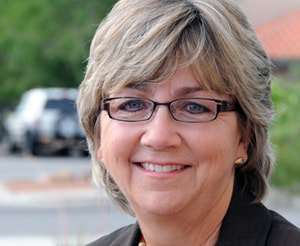
Lt. Gov. Diane Denish (Photo by Heath Haussamen)
The office of Lt. Gov. Diane Denish says the public doesn’t have any business knowing about Denish’s job-related appointments, except for public appearances.
Last week, NMPolitics.net requested a copy of Denish’s calendar or schedule for a 30-day period. Denish’s chief of staff, Joshua Rosen, denied the request on Friday.
Rosen said his office doesn’t keep an “official” calendar of the lieutenant governor’s appointments and isn’t releasing notes or documentation related to her schedule, except to point to news releases that announce public appearances.
“Diane’s public events are announced so that New Mexicans can come see her in their communities,” Rosen wrote in an e-mail. “Her private appointments are not maintained in the state email system and, per direction from the Attorney General, this document is not subject to IPRA (the New Mexico Inspection of Public Records Act). Therefore the Office of the Lt. Governor has no records responsive to your request.”
I asked Rosen to clarify if he was saying the office keeps no calendar for Denish or just that it’s not subject to IPRA. He said the office “schedules events relating to state business” but “does not maintain an official calendar.”
Last week, NMPolitics.net reported that the Third Judicial District Attorney’s Office in Las Cruces is not maintaining a calendar or schedule for District Attorney Susana Martinez, who’s spent a lot of time in recent months on the campaign trail in her quest to become governor.
Martinez declined to say whether she’s keeping her own calendar using equipment not owned by her government office or if no one is keeping a schedule of her work-related appointments. The Attorney General’s Office said such a personal calendar isn’t a public record subject to IPRA.
AG said employee ‘notes’ of appointments aren’t public
Denish’s office does send notices to the media when Denish is appearing in public. But Denish has all sorts of other meetings related to her job, such as appointments with constituents and other elected officials.
Though his office schedules such appointments for Denish, Rosen is contending that documentation of those appointments is not public.
Phil Sisneros, the AG’s spokesman, said last week that the AG believes “personal calendars and schedules are more like notes a public employee keeps for his or her own use, even if they include business appointments,” and are not public records.
But Sisneros didn’t say whether the same applies when employees of a government office schedule appointments for an elected official, as is the case with Denish. That’s because I was asking only about personal calendars, like the calendar Martinez may be keeping.
I’ve e-mailed Sisneros to ask whether an elected official’s schedule, when maintained by that official’s office, is a public record or also considered more like ‘notes’ for personal use. I’ll let you know what response I receive.
‘Governors have virtually no expectation of privacy’
The executive director of the New Mexico Foundation for Open Government, Sarah Welsh, speaking last week about the Martinez situation, said the public records act “applies to all documents regardless of physical form or characteristics that are used, created, etc. by any public body and relate to public business.”
She said if Martinez is keeping a personal calendar and it’s “the primary way that she keeps track of her public work, that’s clearly a public record.”
Welsh could not be reached for comment on Friday or over the weekend about the situation with Denish. But Welsh also said, speaking about Martinez, that from a policy perspective the district attorney should release whatever information she has about her public appointments and events.
“That’s just basic oversight of what a public official is doing,” Welsh said. “… Governors have virtually no expectation of privacy. Everything they do, 24/7, is subject to public scrutiny. That’s one of the hazards of the job, and that’s probably one reason why so few people want it.”
Like Martinez, Denish has spent a great deal of time in recent months away from the office and running for governor.