(4)

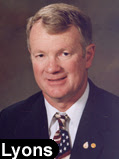
On trip to Las Cruces, Lyons defends land lease

New Mexico Land Commissioner Pat Lyons is in Las Cruces today to defend his decision to lease land on the East Mesa to a developer who has been very friendly with him in the past.

Lyons explained the deal and chastised those who have criticized him this morning on The Morning Show with Michael Swickard.

“They’re trying to connect some dots here that just doesn’t make sense to me,” Lyons said.

Lyons and developer Philip Philippou have come under fire in recent weeks because Philippou gave $20,500 last year to a political action committee that gave most of it to Lyons’ re-election campaign. Then Lyons bypassed his own process for seeking bids to lease 3,200 acres of land on Las Cruces’ East Mesa by giving the contract to Philippou in December, before the announced time to submit proposals had ended.

In addition, Philippou has given another $6,000 to Lyons this year, and lobbyists tied to Philippou, who run the PAC in question, gave at least another $3,600 in cash and in-kind contributions to Lyons last year. And Lyons flew on a plane chartered or owned by Philippou in March to a basketball game in Washington, but says he didn’t know until after the fact that Philippou paid for the flight.

In the interview with Swickard, Lyons said he sought bids to lease the land because a number of developers expressed interest in it. He said he wanted to take pressure off the development of farm land in the Mesilla Valley by helping develop the desolate East Mesa, and also pointed out that his mandate is to make money off state lands for education.

“We don’t get anything for open space,” Lyons said.

Lyons recently told the Las Cruces Sun-News that he made a mistake in accepting Philippou’s bid before the process had ended, but he seemed to back off that comment today. He said Philippou’s master plan was so good that it was worth signing a lease before the end of the announced bidding process.

Lyons said the state estimates that it will make $27,000 per day off the land under the agreement with Philippou, and waiting another month for the end of the bidding period would have resulted in a loss of more than $800,000.

He said he also wanted to hire a local builder to develop the land.

“We didn’t even have to put it out to bid. We just did that to do it,” Lyons said. “We acted on the bids as they came in.”

‘We’re not for sale’

Lyons defended his ride on Philippou’s plane to see the New Mexico State University Aggies play in the NCAA tournament in March, saying it’s not unusual for public officials to be invited to attend such events. He said “there happened to be an open seat” on the plane, and the university president invited him.

“Who paid for it? I don’t know,” Lyons said.

His spokesperson told me yesterday that, at the time, Lyons believed the university was paying for the flight, but he found out after the fact that Philippou did.

Swickard asked whether gifts and campaign contributions from developers influence his actions. Lyons said they don’t.

“They’re trying to pull up stuff from the campaign a year ago,” he said of journalists, including me, who have reported on the contributions. “You know, campaign’s over in November. We don’t care anymore.”

Lyons said he opposes public financing of campaigns and said candidates have to raise money. He said donors “invest in you because they believe in what you can do.”

“We’re not for sale. We never have been, never will be,” Lyons told Swickard, adding that “how you deal with situations like this is what defines what kind of person you are.”

“Our job is to raise money for education, is to take care of our beneficiaries,” Lyons said. “… We’re going to leave a legacy where we did a great job in the State Land Office.”

Lyons plans to speak later today to the Rotary Club and the Sun-News editorial board.

Share


Advertisements

4 comments so far. Scroll down to submit your own comment.

  1. Mr. Baca did not write this – it is an average citizen who took the time to read the Annual Reports of the State Land Commission

  2. JIM BACA needs to get over it!

  3. Listening to Michael Swickard’s congenial radio interview with his friend, Patrick Lyons on May 16th, the Land Commissioner showed a lack of knowledge of his own State Land Office. He stated a number of times that the revenues he raises go directly to the school children – a good political slogan that he used in his campaign. Regardless, in New Mexico, state trust land revenues are generally used to offset not supplement funds for education from the general fund. Revenues from state trust lands become part of the Public School Fund, which in combination with General Fund monies, goes to meet state equalization payments, transportation costs and certain supplemental distributions. The trust land revenues represent about only thirteen percent of the state’s overall pre K-12 budget. Mr. Lyons might like to know that trust revenues do not necessarily translate into increased educational funding in the state.

    For Mr. Lyon’s information, there are twenty-one beneficiaries who receive revenues generated from trust activities in New Mexico. These beneficiaries include: the Common Schools; Eastern New Mexico University; New Mexico State University; New Mexico Institute of Mining and Technology; the University of New Mexico; Western New Mexico University; New Mexico Highlands University; Northern New Mexico Community College; New Mexico School for the Deaf; New Mexico School for the Visually Handicapped; Public Buildings at the Capital; Penitentiary of New Mexico; New Mexico State Hospital; Rio Grande Improvements; UNM Saline Lands; Water Reservoirs; Miner’s Hospital of New Mexico; and the New Mexico Military Institute. Each acre of trust land is designed to a specific beneficiary.

    The State Land Office is trying to exploit the rapid growth of Las Cruces. The Surface Resources Management Program is supposed to identify trust lands ideally suited for development. Such projects often take years to plan carefully. Unfortunately, Mr. Lyons avoided this long process to quickly sell trust land to a developer. Land Commissioner James Baca developed the Mesa del Sol project beginning in 1987 with much public input. The project took years of careful planning. I wonder how long Mr. Lyons worked on the proposed Las Cruces annexation – OBVIOUSLY NOT VERY LONG. For New Mexico residents read the State Land Office Annual Reports from 2003. It is enlightening.

  4. The use of our school children to defend Mr. Lyons actions is wrong. It is politics. He has other funding responsiblities according to the state constitution:

    common schools
    legislative, executive, and judicial public buildings
    penitentiaries
    insane asylums
    schools and asylums for the deaf, dumb, and blind
    miners’ hospitals
    normal schools
    charitable, penal, and reformatory institutions
    agricultural and mechanical colleges
    a school of mines
    military institutes
    county bond payment (once repaid, grant is passed to common schools trust)

    The land commissioner’s office is tainted and needs reforms before more state land is given away for possible political reasons. In addition, the developer’s friend, Mr. Patrick Lyons has declared in the Annual Report of the Land Office, the arrogant policy of being able to sell any state lands to “outside public and private entities” that he deems appropriate or politically beneficial to him. THERE IS absolutely NO OVERSIGHT IN THIS DECISION-MAKING. This office needs to be reformed immediately to protect our lands.

    Under the Ferguson Act of 1898 and the Enabling Act for New Mexico which was passed by Congress, New Mexico was given nine million surface acres of land. These public lands were granted to New Mexico specially to be held as a permanent land grant fund with public schools as the main beneficiary. What is not well-known is the state investment officer invests the land grant permanent fund – not the Land Commissioner. Over the years, the revenue from the Land Office has varied from a low of $97 million to a high of $495 million in fiscal 2006. It is the Land Commissioner’s job to conservatively manage New Mexico’s trust lands, leasing for mineral exploration, development and production, grazing and other commercial purposes. He should act in a prudent manner.

    Mr. Lyons says he wants to pay for education by dipping into our permanent land grant. He has identified 30,000 acres that can be sold to developers. However, there is no reason for selling land to provide additional revenue to the land grant permanent fund.

    Read the 2005 Annual Report of the New Mexico State Investment Council (“SIC”). Mr. Lyons forgets to tell us that the permanent land grant fund is managed by the Council. State law designates that only 5.8 percent of the permanent fund is distributed yearly to public schools. It is a permanent endowment and not a rainy day fund with the beneficiaries (the public schools) receiving distributions of earnings while the principal remains intact based on a good investment strategy. It is the SIC investments that decides the matter. Mr. Lyons does not have to erode the state’s land holdings.

    Here are ideas that other states have adopted to protect and develop state trust lands. The commissioner should create conceptual land use plans for all state trust land in this state for which the commissioner considers to be appropriate. The commissioner shall consult with the city, town or county in which the land is located and with any regional planning organization regarding integrating the conceptual plan into the general land use plan of the city, town or county. It is crucial that there be a land planning oversight committee made up of New Mexico residents and not land commissioner cronies. The land commissioner would submit each plan, and revision of the plan, to this land planning oversight committee for review and approval.

    It would be beneficial that the commissioner create five year disposition plans for all state trust land in this state, based at a minimum on market demand, anticipated transportation and infrastructure availability. Five year disposition plan” means a plan that identifies the land projected to be sold, leased, reclassified for conservation purposes, master planned or zoned during the next five years.

    This should be made available to the public. We need reform as soon as possible.

Leave a response

You must be logged in to post a comment.